

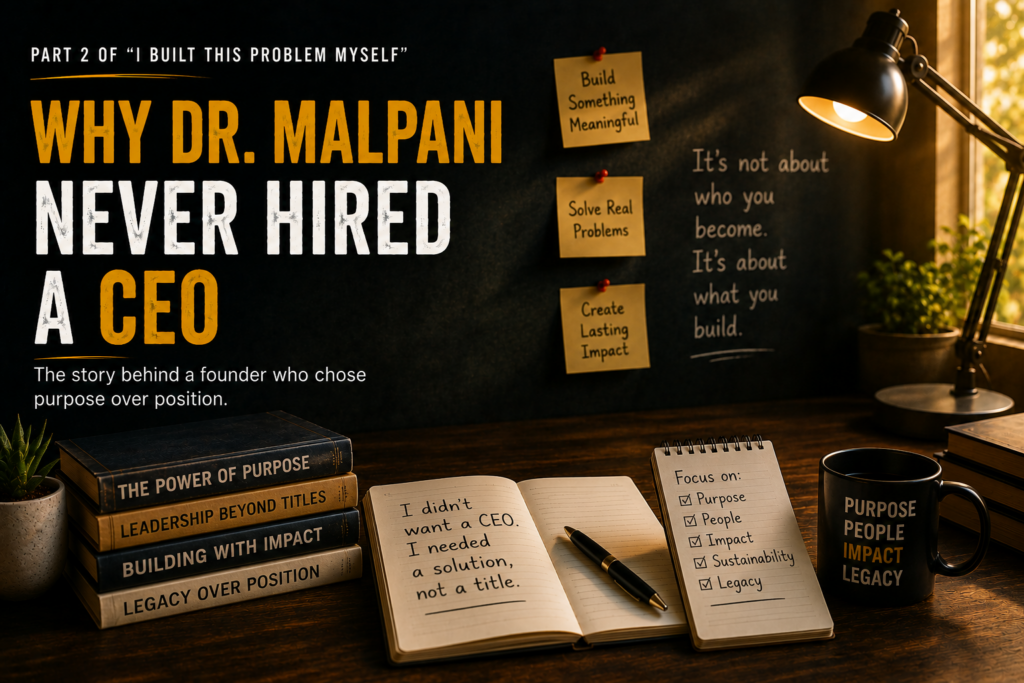



Why Dr. Malpani Never Hired a CEO?
Part 2 of “I Built This Problem Myself”
In the last piece, I wrote about a meeting where Ashish said something that stayed with me: our technology team had accidentally become the hero of our organization’s story. Not because they were arrogant. Not because anyone planned it.
But because a hundred small moments a correction here, a “this isn’t good enough” there had quietly taught every other team a rule nobody ever wrote down: no matter how good you get at your job, tech will always matter more.
I ended that piece admitting I didn’t have the fix. I had a better question “how do we make every team feel like the hero of its own mission?” but not an answer.
I have one now. It took me remembering something that happened to me, about a year and a half before Ashish ever said a word.
The Insecurity I Never Told Anyone About

Around a year, year and a half ago, I was, by most measures, doing fine as a CEO. I was reading the books. The ones everyone tells you to read how to manage a team, how to build a good company, how to become the kind of leader people write case studies about. Apnipathshala was growing. I was proud of the machine we were building.
And then I met someone younger than me with a completely different skill set, doing something better than I could. My ego did not handle it well.
For about a week, I couldn’t stop thinking about it. Should I learn that skill? Would it make me better? I’d catch myself drifting away from actually running the organization and instead obsessing over whether I was falling behind at being something a founder, a CEO, a leader with the right resume.
Then I’d catch myself, come back, and go run Apnipathshala again.
Except it didn’t stay away. It came back, like clockwork, at least once a quarter a full week lost to comparing myself to whoever I’d most recently met who seemed to be doing “better.”
I got sick of it. It had become a bad habit: checking who was ahead, studying what they were doing right, instead of asking a much simpler question about my own work.
Here’s the part that matters: what Ashish described the tech team doing to everyone else, I had already been doing to myself for a year.
What Dr. Malpani Actually Hired Me For
A few days ago, in an unrelated conversation, Dr. Malpani said something that put the whole thing back in front of me.
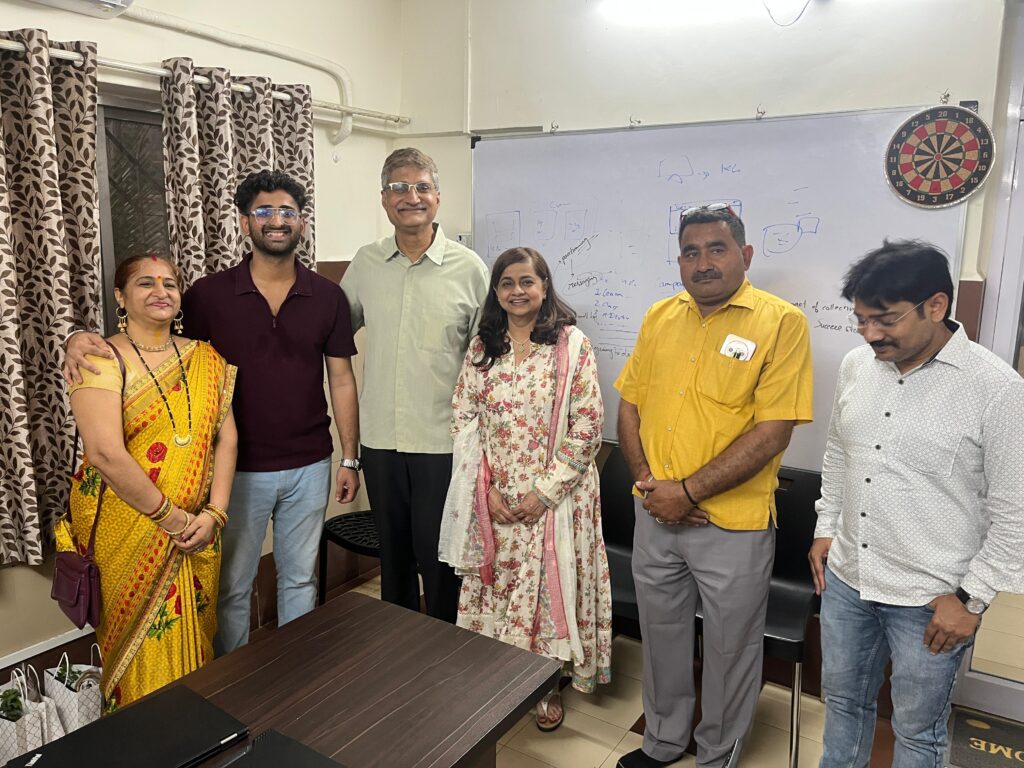
He never hired me to become the best CEO in India. He never told me I needed to be the best manager, the best leader in the nonprofit or education space. That ambition wanting to be a CEO because it sounds good, because it’s a title people respect that was entirely mine. He never asked for it.
He didn’t hire me because I walked in with some exceptional management pedigree either. I’ll be honest I don’t think he ever evaluated me on a skill at all. He hired me because I care about kids.
Not kids in the abstract. Kids in my locality, my community, my city, my district, my state, my country. He hired me to make sure they get the best possible education I can get them whether that means running something as a nonprofit, losing money every year to do it, or however else it has to work. That was the whole brief. Not “build a billion-dollar EdTech company.” Not “run Apnipathshala like a business.” Just: help the kids, by whatever means the mission requires.
That’s the moment the second half of the answer clicked into place.
The Question Everyone Was Asking Wrong
Here’s what I got wrong about the tech team’s problem, and what I’d been getting wrong about my own for a year.
I used to think the fix was about confidence that the marketing team, the ops team, the POD team just needed to believe their skills mattered as much as tech’s. I used to think my own problem was about confidence too that I needed to stop being insecure about my management ability and just trust myself more.
Wrong on both counts.
The tech team isn’t good because they’re good at tech. I’m not a good CEO because I read the books or clocked the hours.
Nobody solves this by getting better at being something a better engineer, a better manager, a better marketer.
The tech team is good because they never set out to build good products. They set out to solve a problem for a kid on the other end of that product. The tech is just the byproduct. And I stopped being a good CEO the moment I started trying to be one collecting the skills, the reading list, the credentials that make someone look like a CEO. I became a good CEO again the moment I remembered the only thing I was actually hired to optimize: how well I use every resource I have the team, the money, the time to help kids. The “good CEO” part is just what that looks like from the outside.
Being vs. Giving
That’s the whole shift, in one line: stop trying to be something. Start trying to give something.
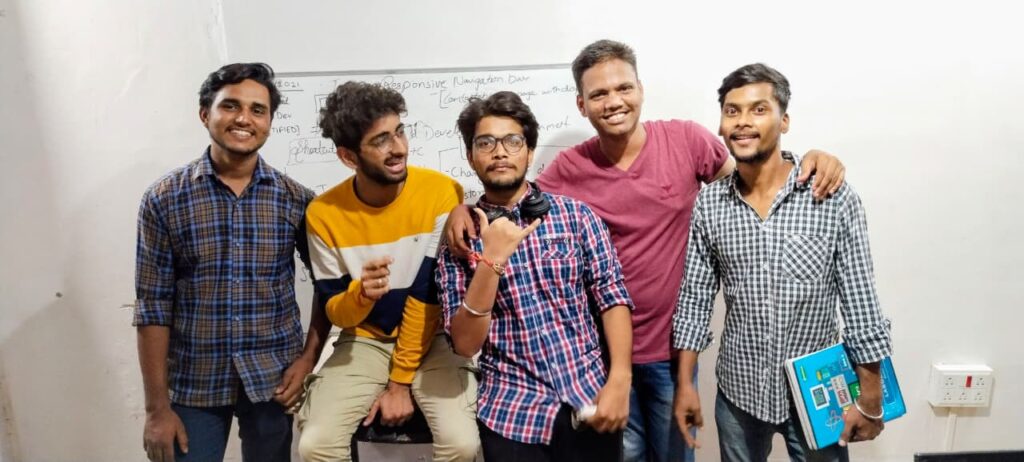
The moment a team stops asking “are we the best marketing team / the best tech team / the best ops team” and starts asking “how does our specific skill move the needle for a kid we’ve never met” the internal hierarchy collapses on its own.
There’s no competition to win, because nobody’s playing the same game anymore. Tech isn’t competing with marketing to be more important. They’re each answering to the same kid, from a different angle.
Ashish never told the tech team to be less good at their jobs. Nobody needs to. A POD team that gets obsessed with becoming a “best-in-class management team” for its own sake will always feel smaller next to tech. A POD team that gets obsessed with what its outreach and coordination does for a specific child in a specific community stops caring what tech is doing entirely because the comparison stops making sense.
That’s how you actually get a team that’s “fucking good” at something, to borrow my own words when I explained this to my team. Not by chasing the skill. By chasing the outcome the skill was always supposed to serve.
Where This Leaves Us
I’m not going to pretend this fixed everything overnight, the way these stories sometimes get told. What it did was give every team including me a different question to carry into the room.
Not “am I as good as they are.”
But “what does this get a kid, that they wouldn’t have had without me.”
Dr. Malpani never hired a CEO. He hired someone who cared enough to become whatever the kids needed him to become.
Turns out that’s the only job description any of us actually had tech, marketing, POD, management, all of it. We’d just been reading it wrong.