
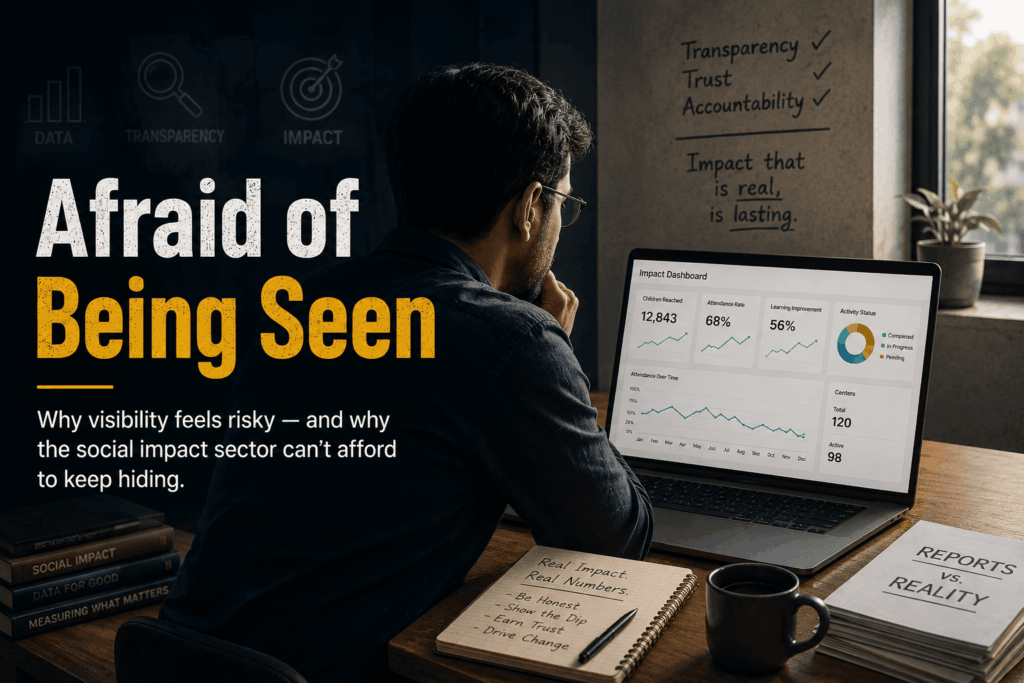




Afraid of Being Seen
Last week I sat in a room full of people who work in the development sector funders, founders, program leads, people who have spent years trying to fix real problems for real people. The topic was AI and digital transformation in social impact. I went in expecting excitement. I left with a very different feeling.
The room was not anti-technology. It was skeptical. And the more I sat with that skepticism, the more I realised it wasn’t really about technology at all. It was about something older and more uncomfortable: visibility.
Digital systems don’t just help you do more. They also let people see more what’s working, what isn’t, where the money went, where it didn’t, which numbers are real and which ones were rounded up to look better in a report. And I think that’s the part a lot of organisations, including ones I’ve worked closely with, are quietly afraid of.
A story that isn’t about anyone in particular
Let me tell you about an organisation I’m going to call Disha. Disha doesn’t exist but if you’ve spent time in this sector, you’ve met a version of her.
Disha ran learning centres in a cluster of villages. Every quarter, she filed a report: number of children reached, number of sessions held, “improvement in learning outcomes.” The numbers always trended upward. Funders liked upward. Boards liked upward. So Disha’s team learned, without anyone ever saying it out loud, to make sure the graph kept climbing.
Then one year, a funder asked for raw attendance logs instead of the summary sheet. Not because they suspected fraud they were piloting a new dashboard and wanted to test it on real data. Disha’s team spent three sleepless nights reconciling registers that hadn’t quite been reconciled before. The final numbers were still decent. Just not as decent as the reports had suggested for the last two years.
Nobody had lied, exactly. Attendance was rounded up “since the child usually comes.” A test score was recorded as “improved” because the facilitator remembered the child seemed sharper this term. Small, human, forgivable shortcuts. But stacked over eight quarters, across forty centres, they added up to a story that was more hope than fact.
Disha wasn’t corrupt. She was scared. Scared that the real number would look like failure. Scared that a funder would read a dip in attendance as a reason to walk away, instead of as the normal, messy texture of working with children in difficult circumstances. So the system quietly optimised for the number that kept the lights on, not the number that was true.
I made Disha up. But I’ve sat in enough rooms, and read enough reports, including some of my own organisation’s, to know she’s not rare.
The money makes this bigger than any one story
This isn’t a small, local problem. Corporate CSR spending in India crossed roughly ₹34,900 crore in the most recent full year on record, up sharply from around ₹24,800 crore a decade earlier. That is a lot of intent to do good, flowing every single year into a sector that is still, in many corners, measured by the story it tells rather than the data it can show.
And even where the money does reach the ground, unspent CSR funds hit a five-year high of roughly ₹1,475 crore in one recent year, with thousands of companies falling short of what they were required to spend. Some of that is planning failure. Some of it, I suspect, is funders and implementers both being cautious about deploying money into systems they can’t fully verify.
Separately, a due-diligence review of NGOs seeking a public trust certification found that about one in five needed real capacity building just to disclose their governance and articulate their impact honestly. Not because they were hiding something sinister but because the muscle of transparent reporting was never really built. Nobody trained anyone to say “we didn’t hit the target this quarter” and have that be an acceptable sentence.
That’s the gap Disha lives in. Multiply her by thousands of organisations, and you start to understand why a room full of good, well-meaning people gets quiet and a little defensive the moment someone says “dashboard” or “real-time data.”
What I think is actually going on
I don’t think this sector is short on honest people. I think it’s short on a culture where an honest number is safe to share.
Technology just makes that fear visible faster. A spreadsheet can be softened. A live dashboard cannot. When you introduce a system that shows attendance in real time, or tracks whether a “trained” facilitator actually delivered the training, you’re not just introducing a tool you’re introducing a mirror. And a lot of organisations have never been asked to look in one, at least not one that anyone else could also see.
I don’t say this from a distance. I’ve built tools inside my own organisation and then quietly worried about what they’d reveal about my own execution gaps. It’s uncomfortable to build the exact system that will tell you, in numbers, where you fell short. I understand the instinct to slow that down, to explain the dip before showing the graph, to keep the raw data one layer removed from the people funding you.
But I think that instinct, multiplied across an entire sector, is exactly what’s holding the sector back. Funders start writing bigger checks not when NGOs promise perfect outcomes, but when they can survive an honest quarter without losing trust. That trust doesn’t get built by hiding the dip. It gets built by showing it, explaining it, and showing what changed because of it.
Where I’m landing
If there’s one thing I’m taking away, it’s this: the goal isn’t to build more tools that measure people. It’s to build a culture inside my own organisation first where an honest, unflattering number is treated as useful information, not as a threat to be managed.
Disha’s team didn’t need better technology. They needed permission to say the real number out loud the first time, not the third year, after a funder forced the question. That permission is cheaper to build than any dashboard. It’s also, I suspect, a lot harder.
I don’t have this fully figured out. But I’d rather start asking the uncomfortable questions of my own systems now than have someone else’s dashboard ask them for me later.