

What “Quality Education” Means for an Entire District
Two months ago, I was sitting outside a government office in Raichur, waiting.
Getting there wasn’t easy. Mumbai to Hyderabad, then a four to five hour drive from Hyderabad to Raichur, just to reach one meeting. By the time I got to the Zilla Panchayat CEO’s office, I’d already convinced myself I understood how this would go. I’d done this enough times to have a script running in my head.
I waited for a few hours. My first reaction, if I’m honest, was mild irritation.
He’s late.
He wasn’t late.
He’d been in his cabin since early morning, running back to back to back meetings with villagers, local stakeholders, other organizations, I don’t even know who all. By the time it was my turn, I estimate he’d already had ten to fifteen meetings that day, and from what I could tell, he was the actual decision maker in every one of them. I wasn’t even the last person on his list.
I remember sitting there thinking: I have no real reference point for how many meetings an IAS or IPS officer has in a day. But whatever the average is, this felt like a lot.
The pattern I didn’t want to admit
We’ve been doing this, walking into government offices, school departments, police welfare cells, municipal bodies, for a few years now. I’ve lost count of the proposals, the meetings, the committees we’ve sat across from, trying to get someone to understand what Apnipathshala actually does and how it could help the kids in their city, their district, their state.
For a long time, when things didn’t move, I assumed the fault was mine. Maybe the proposal was weak. Maybe I hadn’t understood what they actually needed. Maybe I wasn’t communicating the impact clearly enough.
But after enough of these meetings, including some real wins with bodies like Mumbai Police and BMC, a pattern became impossible to ignore.
The proposal wasn’t the variable.
The idea, the model, the pitch, none of that was the deciding factor.
The one factor that actually determined whether a district’s kids got help was the mindset of the one person across the table.
How much they personally cared.
Not about the paperwork.
Not about optics.
About the students.
Five minutes, extended by nobody’s clock but his own
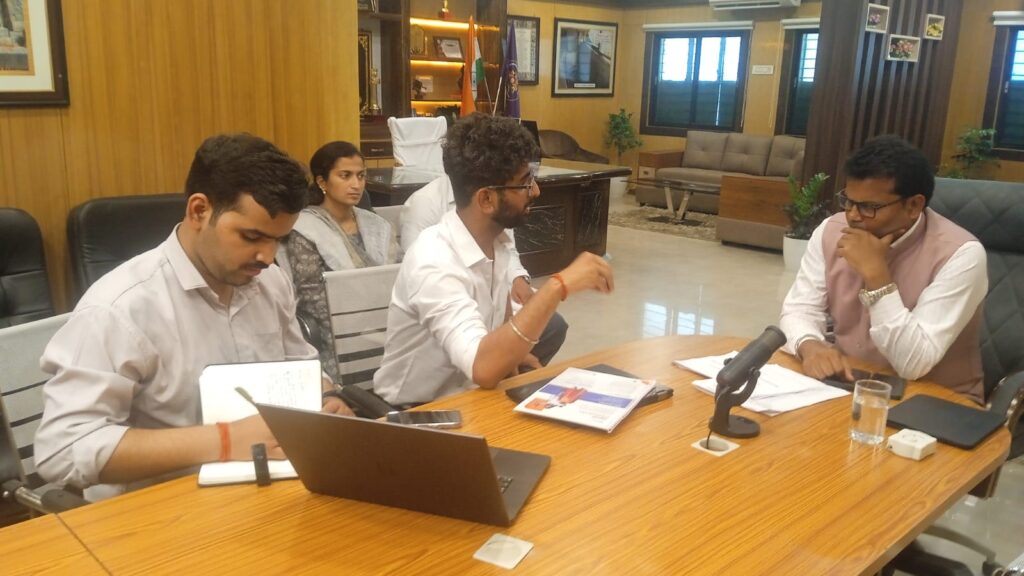
The meeting with Ishwar Kandu sir was supposed to be thirty minutes. The moment we walked in, he told us straight:
“You have five to ten minutes, then I have another meeting.”
Fair enough, I thought. I’d learned to compress our whole pitch into a tight window.
I started explaining Apnipathshala, the community led learning model, hundreds of thousands of students, a hundred plus centers running across India, and then Eklavya AI, our AI teacher companion for students. I was moving fast, trying to fit everything in.
Somewhere in the middle of it, something shifted.
Ishwar sir sat down.
He asked us to sit too.
The five minute meeting kept going.
And then, after hearing the scale of what we’d built, he said something I did not expect:
“I don’t want this.”
A few of us were genuinely stunned.
He explained why.
What we were pitching, he said, was too aspirational for what Raichur needed right now. Yes, we could bring digital literacy, we could shift the culture of learning at scale, he could see that.
But his actual problem was narrower and, in his words, more honest:
On paper, literacy numbers in his district looked fine.
Internally, he knew his students were struggling with the fundamentals, Foundational Literacy and Numeracy (FLN).
That’s what he wanted solved.
Not the ambitious version of us.
The useful version of us.
We had never built anything specifically for that age group, for that problem, before.
Then he said the line that has stayed with me since:
He’d rather solve the fundamentals first, before chasing every other problem in the district.
He wanted every student in Raichur to have basic math and literacy locked in before anything else.
I’ve sat across from a lot of senior officers.
I was not prepared for that level of ground level clarity from an IAS officer about his own district’s real, unglamorous problem.
The confession I almost didn’t make
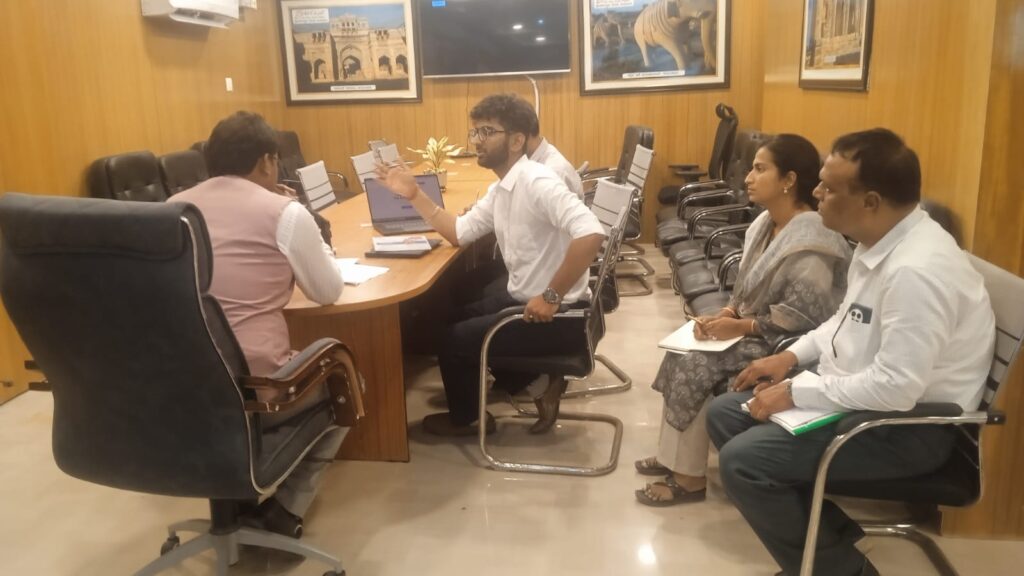
That’s when he introduced us to Ranjitha ji, the ADP, who would become our point of contact for the next two months.
Before we agreed to anything, I had to say the quiet part out loud, and I was genuinely hesitant to say it to a CEO.
The truth is, our biggest fear was never whether we could build the product.
It was bureaucracy.
One small approval, in most government partnerships, can take months.
I cannot build an AI FLN model on that timeline.
I said as much, half expecting the usual reassurances that go nowhere.
Ishwar sir finished my sentence for me.
He said he understood exactly where that fear came from, and he made a direct promise:
No unnecessary bureaucracy on this project.
If we delivered, he’d back us to reach more of Raichur’s students.
We took the deal on the strength of that one conversation.
Lunch at 5 PM, and a promise I didn’t expect from a government office
We met Ranjitha ji properly over what was technically lunch, at 5 PM, after her meetings finally ended.
What she said that afternoon is something I don’t think I’ll hear again in a government office, so I want to get it right.
She told us she cared about the students before anything else.
She didn’t know how long she’d be posted in that role, nobody in that seat ever really knows.
But for as long as she was there, she wanted to give us her full support, because she could see we actually cared about the outcome for these kids, and so did she.
That sentence did something to my confidence in the project that no proposal deck ever could.
Three weeks to build, and the part nobody sees
We built the first version of the FLN model in three weeks.
Iterations, feedback loops, more iterations.
Two months in, we’re now launching the pilot across a set of schools in Raichur.
Here’s the part I want to be honest about, because it’s easy to only credit the tech team for shipping an AI model in three to four weeks.
That speed wasn’t just us.
It was Ranjitha ji, before and after her own office hours, answering what were sometimes genuinely silly, repetitive questions from me, because building something this specific for a district requires knowing exactly what they expect, what outcome they’re actually measuring against, again and again until it’s precise.
She never once treated that as a disturbance.
She treated it as the project actually happening.
I run a twenty five person team.
I’m twenty five myself.
I work with Dr. Malpani, where the entire operating principle is speed, how fast can you run the experiment, how fast can you show the result, how fast can you fail and move on.
That’s the environment I come from.
So it genuinely broke a pattern in my head when, one day, Ranjitha ji called me, not to slow us down, not to add process, but to say:
The quality is good, the product is good, but we need to move faster. We’re behind.
A government office telling me to move faster.
What I actually learned
And somewhere in that phone call, it hit me. This might be the start of Raichur becoming the first district in India to actually adopt AI for education, not as a pilot on paper, but as something a district CEO and an ADP fought internally to make real.
I didn’t come out of this thinking Raichur is proof that government partnerships are suddenly easy.
I came out of it with a much narrower, much more useful belief:
The deck doesn’t move a district.
The model doesn’t move a district.
A person who has already decided, quietly and independently, that the kids in front of them matter more than the optics of the job, that’s what moves a district.
Ishwar sir had that clarity before we ever walked into his office.
Ranjitha ji had that urgency before we ever asked for it.
We didn’t create their conviction.
We just happened to be standing in front of them with something that matched it.
The pilot launches now.
If it works the way the last two months suggest it will, Raichur won’t be the last district where this happens, but it will be the one that taught us what to actually look for the next time we walk into an office and wait.